Research

Mechanistic models, and the tools to analyze them

My research has two complementary threads: building biophysically grounded models that explain experimental observations at the level of specific mechanisms, and building software that makes rigorous dynamical analysis of such models practical and reproducible.

01

Developing new mathematical models

Multiple timescale dynamics of conductance-based models of brainstem locomotor neurons

A. K. Thomas & J. E. Rubin (2026). arXiv:2603.11467, under review at SIAM Life Sciences.

The pedunculopontine nucleus (PPN) is a heterogeneous brainstem locomotor hub implicated in Parkinson’s disease and a target for deep brain stimulation (DBS). Existing PPN models are either population-level firing-rate models or small conductance sets calibrated to a single cell type, and they fail to reproduce the distinctive single-cell dynamics observed experimentally.

We developed three single-compartment Hodgkin–Huxley-type models from the ground up for the cholinergic (C), cholinergic with low-threshold Ca2+ spikes (CT), and non-cholinergic (NC) PPN cell classes. Each model reproduces its class’s stimulus-dependent responses, including post-inhibitory rebound, transient low-threshold spiking, and gamma-band (30–90 Hz) oscillations. The models combine Na+, K+, P/Q- and T-type Ca2+, A-type K+, and Ca2+-activated K+ currents with intracellular calcium dynamics.
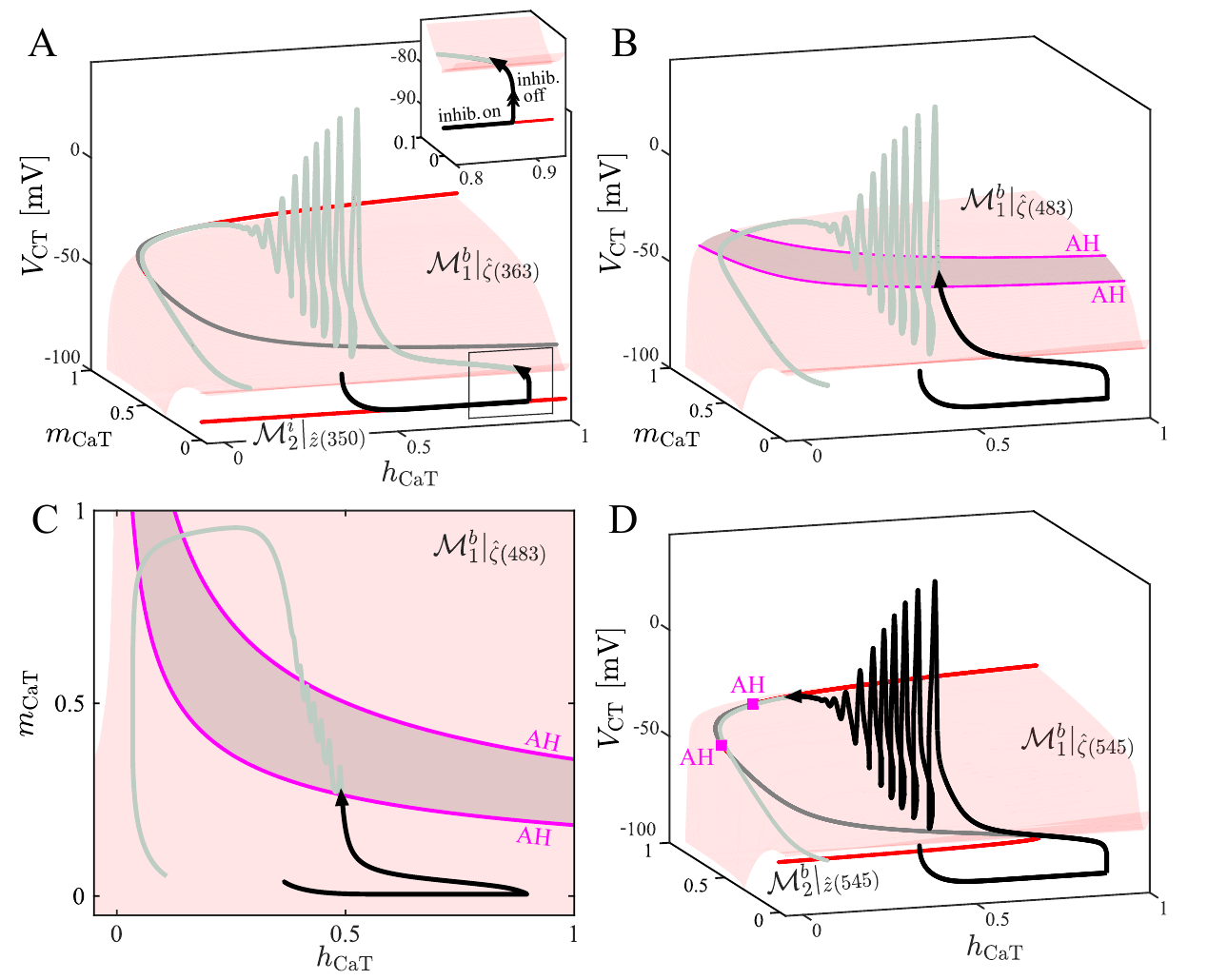
Four-panel figure showing a trajectory of the CT neuron model moving across critical and superslow manifolds, with Andronov-Hopf bifurcation curves marking the onset and offset of rebound oscillations.
Three-timescale geometry of post-inhibitory rebound in the CT model. When inhibition is released, the trajectory jumps from the superslow manifold ℳ2 to the critical manifold ℳ1 (A). Rebound oscillations begin as it crosses a subcritical Andronov–Hopf curve of the fast subsystem (B, C) and terminate at a second AH bifurcation as the superslow variables drift (D). From Thomas & Rubin (2026), Fig. 8.

Approach

We nondimensionalized each model to separate the variables into fast (membrane potential, fast gating), slow, and, in the CT model, superslow classes (slow gating and calcium). We then used geometric singular perturbation theory and bifurcation analysis of the fast subsystem, parameterized by the slower variables, to explain each transient response. Unlike most analyses of this type, capturing some of these responses required accounting for the voltage dependence of the gating timescales themselves.

Key results

  • C model: the delay before firing resumes after inhibition arises from slow A-current (IA) gating.
  • CT model: T-type Ca2+ kinetics are the dominant control of post-inhibitory rebound oscillations, which are organized by three-timescale dynamics.
  • NC model: P/Q- and T-type Ca2+ conductances together shape high-voltage gamma oscillations and low-threshold spikes; spiking initiates at a fast-subsystem SNIC bifurcation.
  • Prediction: under an untested post-inhibitory facilitation protocol, only the cell classes expressing T-type Ca2+ current (CT and NC) show facilitation, each with a distinct signature.

Why it matters

The models tie distinct firing phenotypes to specific ion channels. This is the level at which pharmacological and stimulation-based interventions act, and it suggests how inhibitory input from the substantia nigra pars reticulata and DBS-like stimulation may differentially shape output across PPN cell types in motor circuits.
Methods

  • Hodgkin–Huxley models
  • Nondimensionalization
  • Geometric singular perturbation theory
  • Bifurcation analysis
  • Three-timescale dynamics
  • Model calibration to electrophysiology
02

Developing mathematical tools

XPPLORE: Import, visualize, and analyze XPPAUT data in MATLAB

M. Martin*, A. K. Thomas* & G. B. Ermentrout (2025). International Journal of Bifurcation and Chaos, 35(13), 2550165. Open access.  *Equal contribution.

XPPAUT, which couples the XPP integrator with the AUTO continuation engine, is a standard tool for bifurcation analysis in mathematical biology and neuroscience. Existing toolboxes built around it only parse the summary .dat exports. The richer .auto files hold the full continuation output: numerically approximated limit cycles, boundary-value problem solutions, eigenvalues and Floquet multipliers, and the settings used to compute them.

XPPLORE is a free MATLAB toolbox that parses .auto, .ode, and .dat files into structured data: the model, branches, labeled points, eigenvalues, and periodic-orbit trajectories. This opens up post-processing analyses that were previously impractical, without changing the XPPAUT workflow.

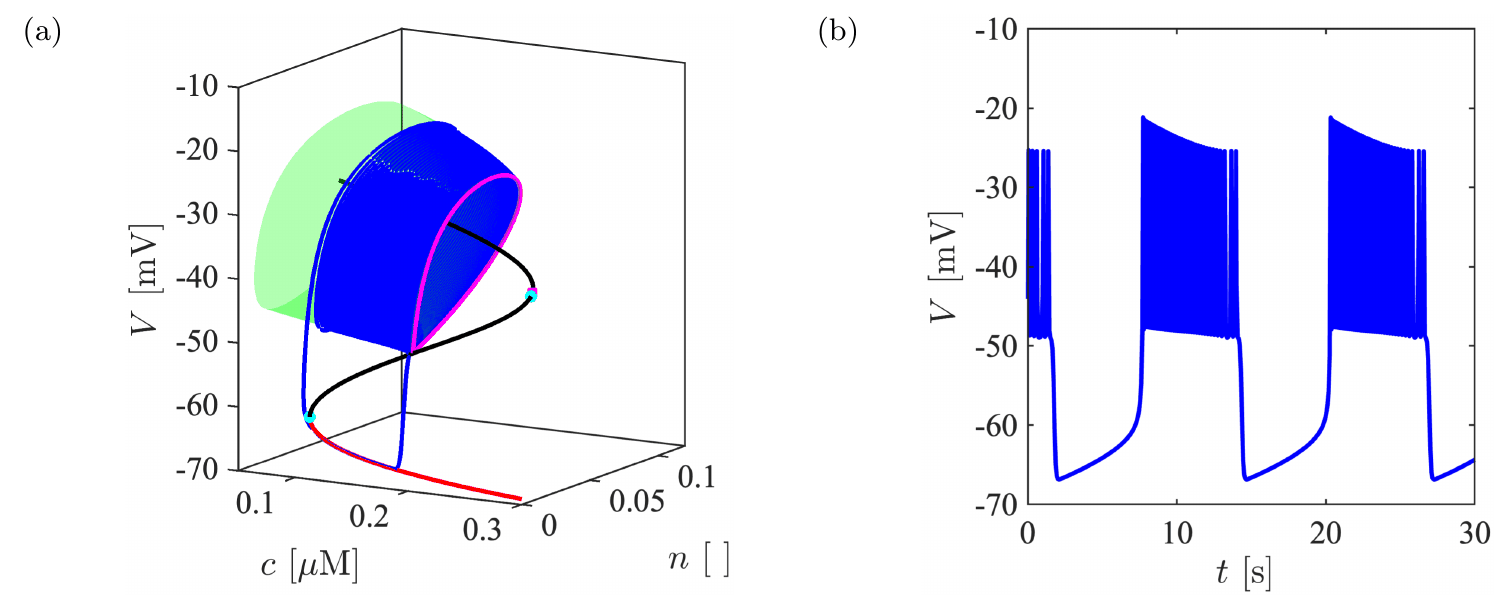
Left: 3D plot of a reconstructed manifold of limit cycles with a bursting trajectory wrapping around it and an S-shaped curve of equilibria. Right: time series of the bursting voltage trace.
Reconstructing a manifold of limit cycles from continuation data. (a) The manifold of stable periodic orbits of the fast subsystem (green), reconstructed from AUTO output for a Chay–Keizer-type model of pancreatic β-cell bursting, together with a bursting trajectory (blue), the homoclinic orbit (magenta), and the S-shaped curve of equilibria. (b) The corresponding voltage time course. From Martin, Thomas & Ermentrout (2025), Fig. 14, CC BY 4.0.

Capabilities

  • Publication-quality one- and two-parameter bifurcation diagrams, nullclines, and simulations, including combined 1P/2P diagrams in 3D.
  • Visualization of eigenvalues and Floquet multipliers along every branch.
  • Averaging along branches of periodic orbits to analyze slow dynamics in fast–slow bursters.
  • Reconstruction of invariant manifolds, including families of limit cycles and attracting/repelling slow manifolds computed as boundary-value problems.

Why it matters

Mechanistic modeling depends on being able to interrogate a model’s structure, not just simulate it. XPPLORE turns continuation output into scriptable, reproducible analyses, lowering the barrier to rigorous dynamical analysis for students and researchers working with ODE models.

Methods

  • Numerical continuation (AUTO)
  • Bifurcation analysis
  • Averaging theory
  • Invariant manifold reconstruction
  • MATLAB software design